
Building services and facility upgrades often require contractors to work above floor level while coordinating around existing equipment, occupied areas, and ongoing operations. Tasks such as installing ventilation ducts, upgrading lighting, maintaining overhead pipes, and servicing electrical systems demand safe access and efficient material handling. Selecting the right machinery helps reduce unnecessary repositioning, improve workflow coordination, and manage site risks. For facility managers and commercial contractors, understanding the roles of access platforms and telehandlers is an important step in planning these projects.
Supporting Maintenance and Installation at Height
Commercial buildings contain extensive networks of lighting fixtures, cable trays, ventilation systems, fire protection equipment, and other overhead services. Reaching these components with ladders may be impractical when work requires both hands, tools, or repeated access to several locations.
An elevated work platform provides a designated working area for personnel, allowing technicians to position themselves closer to the task. Depending on the equipment type, it can support installation, inspection, repairs, and scheduled maintenance. Contractors should select the platform according to required height, available floor space, rated capacity, and the clearance needed around existing building systems.
Improving Efficiency During Facility Upgrades
Renovation projects frequently involve multiple trades working within limited spaces. Mechanical contractors may install ductwork while electricians route cables and maintenance teams replace fixtures. Poorly coordinated equipment movement can interrupt these activities, create congestion, and extend project schedules.
Mobile access equipment can help crews move between designated work areas without repeatedly assembling and dismantling temporary access structures. However, indoor suitability depends on factors such as turning radius, floor loading, overhead clearance, power source, and ventilation. Electric-powered equipment may be preferable in enclosed spaces where exhaust emissions are a concern, provided its capacity and operating requirements match the task.
Planning equipment routes before work begins also helps protect finished floors, avoid obstructions, and separate personnel from material-handling operations.
Where an Off Road Telehandler Adds Value
Not every facility upgrade takes place entirely indoors. Contractors may need to transport HVAC units, steel components, pallets of building materials, or installation supplies between loading areas, temporary storage zones, and elevated work locations. Outdoor construction areas can include gravel, uneven ground, and unfinished access roads.
An off road telehandler can support these material-handling requirements when its lifting capacity, reach, and terrain capabilities match the site. Unlike a personnel lift, a telehandler primarily handles loads using forks or other approved attachments. This distinction matters when planning work that involves both moving materials and positioning technicians.
Using separate machines for material delivery and personnel access can improve workflow coordination. A telehandler can transport compatible loads to designated staging points, while a suitable access platform supports technicians performing overhead installation. Site supervisors should coordinate travel paths, lifting zones, and work sequences to reduce interference between operations.
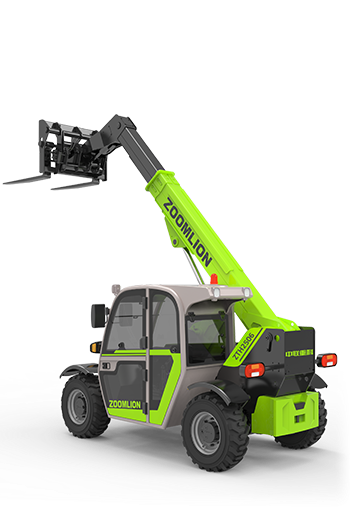
Evaluating the Zoomlion Access ZTH2506
For contractors seeking material-handling equipment for facility construction and outdoor upgrade work, Zoomlion Access offers the ZTH2506 non-rotating telehandler. The model is CE certified and features a maximum lift height of 6 m and a rated capacity of 2,500 kg. Its published specifications also list a weight of 4,970 kg and a maximum forward reach of 3.43 m.
The ZTH2506 uses a four-wheel-drive system with front and rear driving axles and an anti-slip differential. These features are intended to provide traction across suitable challenging terrain. Its hydraulic cylinder-driven boom extension system supports controlled extension and retraction, helping operators position loads within the machine’s permitted working envelope.
The model also features a 10.1-inch display integrating monitoring and control functions. Standard floating forks support conventional material handling, while optional attachments include a platform, bucket, and boom. Contractors should confirm attachment compatibility, capacity limits, and operating procedures with the manufacturer before specifying the machine for a particular application.
Choosing the Right Equipment Configuration
Equipment procurement should begin with a review of the work rather than a preference for a particular machine category. For personnel access, buyers should compare platform height, rated load, platform dimensions, power source, and maneuverability. For material handling, they should assess load weight, lift height, forward reach, ground clearance, and terrain conditions.
When considering an elevated work platform for an indoor upgrade, teams should also verify floor-bearing capacity and ensure that the machine can pass through doors and service corridors. Outdoor work may require different tires, traction characteristics, or lifting capabilities.
A telehandler fitted with an optional personnel platform must not be treated as interchangeable with a dedicated access lift. Personnel lifting is appropriate only when the specific machine, attachment, and configuration are approved for that purpose and operated according to the manufacturer’s instructions and applicable regulations.
Integrating Safety into Daily Operations
Safe equipment use requires more than selecting machinery with suitable specifications. Before work begins, supervisors should inspect the work area for overhead obstructions, electrical hazards, unstable ground, trenches, and pedestrian traffic. Equipment operators need appropriate training and authorization, and daily inspections should cover controls, tires, hydraulic systems, attachments, and other safety-critical components.
For access platforms, workers must remain within rated load limits and use the prescribed fall-protection measures. For telehandlers, operators should follow the load chart for the actual boom position and attachment, maintain a stable operating configuration, and avoid lifting loads beyond permitted limits. OSHA also emphasizes hazard assessment, training, maintenance, and adherence to equipment instructions for aerial lifts.
Clear communication between facility managers, contractors, and equipment operators helps establish exclusion zones and coordinate deliveries with overhead work. These measures reduce avoidable interruptions while supporting a more controlled working environment.
Building a Practical Equipment Strategy for Facility Upgrades
Facility upgrades combine personnel access, material movement, and coordination across different work areas. An elevated work platform is suited to approved tasks that require workers to reach overhead systems, while an off road telehandler can help move materials across suitable outdoor terrain. Each machine has a distinct role, and the appropriate choice depends on the task, site conditions, and operating limits.
The Zoomlion Access ZTH2506 offers a 6 m maximum lift height, a 2,500 kg rated capacity, four-wheel drive, and optional attachments for different material-handling requirements. Contractors can evaluate these features alongside their access-equipment needs to develop a coordinated fleet strategy. Matching machine capabilities to specific tasks helps facility teams plan upgrades more efficiently without compromising safe operating practices.

